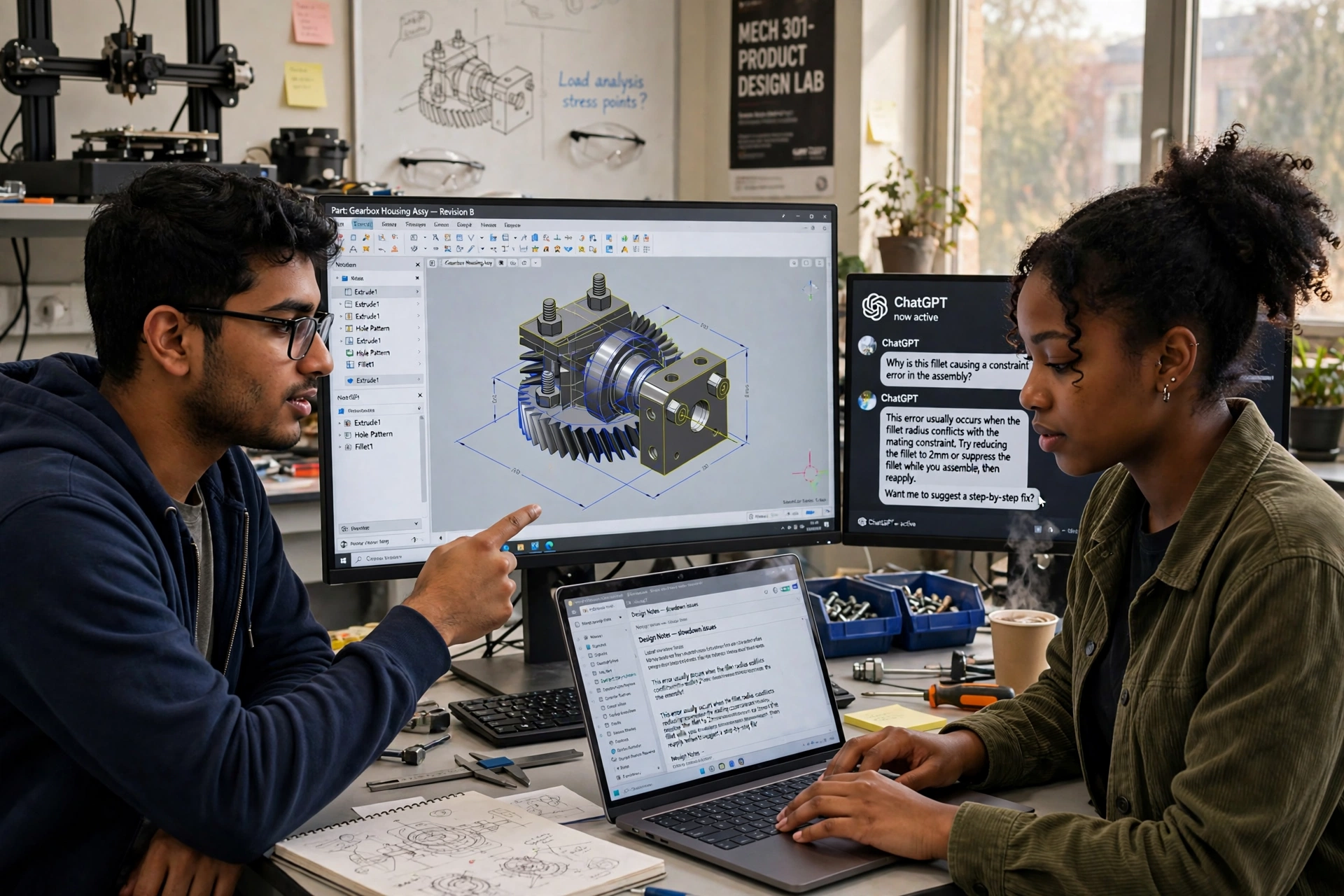
Two students. One screen. One CAD model that has to be perfect.
Now add ChatGPT to the mix.
You’d think it would be like adding a third genius to the team. Faster. Smarter. Fewer mistakes.
It wasn’t.
In a real experiment with 44 mechanical engineering students in Zagreb, the pairs who used ChatGPT actually finished less of their collaborative CAD tasks than the pairs who didn’t. Not a little less. Noticeably less — especially when the task was really about CAD itself.
If you’re a student, teacher, or engineer who has felt that weird, guilty feeling — “I asked AI for help and somehow I’m more confused than before” — this study finally explains why.
And it also shows exactly how to use AI so it helps instead of hurts.
What The Study Actually Did (No Hype, Just Facts)
This wasn’t a survey. It wasn’t “do you like ChatGPT?” It was a controlled experiment.
Who: 44 mechanical engineering students (undergrad + graduate) from the University of Zagreb
How: 22 pairs, working together
What: 3 different collaborative CAD tasks
Condition: Same tasks, with and without ChatGPT support
Measured: Completeness — did they actually finish all the required features, dimensions, constraints, and details of the model?
Does ChatGPT help equally for all kinds of engineering knowledge — or does it help for some tasks and hurt for others?
Answer: It depends. A lot.
The Headline Result Everyone Missed
Here’s the nuance the original coverage buried:
1. For pure CAD tasks, ChatGPT hurt completeness.
When the task was about knowing how to do something in the CAD software — which sketch to use, how to constrain it, how to build a feature tree that doesn’t break — ChatGPT made pairs finish less. Why? Because ChatGPT is brilliant at words. CAD is not words. CAD is clicks, constraints, geometry, and spatial thinking.
ChatGPT would give a confident, general, plausible-sounding answer. The students would follow it. Then they’d spend 10 minutes undoing it. Then they’d argue about who misunderstood whom. Meanwhile, the pair without AI just tried it, failed fast, and fixed it in the software.
That’s the Translation Tax. Every time you translate a 3D problem into text, ask a text model, then translate the text answer back into 3D, you lose time, precision, and momentum.
2. For open-ended engineering tasks, ChatGPT helped a little.
When the task needed general engineering knowledge — “what materials make sense here?”, “what are the trade-offs of this mechanism?” — ChatGPT was useful. It gave the pairs a starting point, a checklist, a way to unblock a discussion.
It didn’t make them finish more overall. But it did reduce the feeling of being stuck.
In other words: ChatGPT is a great brainstorming partner and a terrible CAD operator.
Why Two Smart People + One Smart AI = Slower?
This is the part that feels counter-intuitive until you’ve lived it. Collaboration already has friction. AI adds a second kind of friction.
1. The “Third Teammate” Problem
In computer-aided design, two students have to share one mental model: What are we building? What’s done? What’s next? That’s hard enough.
Add ChatGPT, and now you have to manage a third mental model: What did ChatGPT mean? Is that right? Do we trust it?
Students in other studies reported the exact same thing: ChatGPT increased coding efficiency in programming tasks, but decreased creativity, code readability, and collaborative engagement. The team stopped talking to each other and started talking to the bot.
2. The Confidence Trap
ChatGPT never says, “I don’t know.” It says, “Here’s how to do it!” in perfect grammar.
For a novice, that confidence is hypnotic. You stop verifying. You stop thinking. A separate study of 623 college students found the exact same pattern: without verification, ChatGPT use lowered learning efficiency. With verification, it improved it. Verification was the switch.
In CAD, verification isn’t reading — it’s modelling, checking dimensions, running a simulation. If you skip it because the answer sounded right, you pay for it later in rework.
3. Procedural vs. Conceptual Knowledge
Think of it like learning to drive.
Conceptual knowledge is: “A roundabout gives way to traffic already in the circle.” ChatGPT is amazing at that.
Procedural knowledge is: actually steering, checking mirrors, feeling the clutch. You can’t learn that by reading a paragraph. You learn it by doing it, messing up, and doing it again.
CAD is 90% procedural. ChatGPT is 100% textual. That mismatch is the whole story.
This Isn’t Just CAD. It’s Everywhere.
The same pattern is showing up in other fields:
Programming: Faster completion, but less creativity and worse teamwork.
Design hackathons: ChatGPT finished 2nd out of 6 teams for idea generation, but abandoned promising concepts at the first difficulty and added unnecessary complexity.
Biomedical engineering: Students using ChatGPT, Copilot, and Gemini for a finger-basketball toy project produced AI solutions with multiple mistakes that didn’t meet requirements. Their manual work was better — because they had the skills to judge the AI.
The lesson isn’t “AI is dumb.” The lesson is: AI makes you faster at the parts you already understand, and slower at the parts you don’t.
It’s exactly like real-time data in betting apps. Real-time odds are only useful if you understand the game. If you don’t, faster data just helps you lose money faster, with more confidence. Speed without judgment is a liability.
So Should Students Ban ChatGPT From CAD Labs?
No. Banning it is lazy teaching, and it doesn’t prepare anyone for real work. In real engineering jobs, you will use AI. The question is how.
Here’s the protocol that actually works — stolen from the best teachers, the best teams, and the study itself:
The 3-Phase CAD + AI Protocol
Phase 1: No AI (First 15 Minutes) — Think Together
Sketch on paper. Agree on the feature tree. Decide who drives and who navigates. If you can’t explain the part in plain English to each other, you’re not ready for AI.
Phase 2: AI As Consultant (Middle 10 Minutes) — Ask, Don’t Outsource
Use ChatGPT for what it’s good at, with prompts like:
“List 3 ways to model a revolved boss with a through-hole. What are the pros/cons of each for later edits? Don’t give me steps, give me trade-offs.”
“What material would you choose for a bracket that holds 50kg in vibration? Explain your reasoning so I can check it.”
Notice what you didn’t ask: “How do I do this in SolidWorks?” That’s where the Translation Tax kills you.
Phase 3: No AI (Last 30 Minutes) — Build, Verify, Argue
Close the chat. Model it. Check dimensions. If it breaks, fix it together. One person drives, one person watches for errors. Talk out loud. That talking is the learning.
A Cheat Sheet For Teachers (Steal This)
Instead of This
Do This
“Don’t use ChatGPT”
“Use ChatGPT, but show me your prompt + your verification”
Grade only the final CAD file
Grade the file + a 200-word “What AI suggested, what we rejected, and why”
One long CAD task with AI
Same task twice: once without AI, once with AI, compare completeness
AI for step-by-step instructions
AI for trade-offs, materials, and design alternatives
Silent solo work
Pair work with assigned roles: Driver / Navigator / Verifier
That last row is the secret. The Zagreb study wasn’t about individuals. It was about pairs. When you assign a Verifier, you force verification — and verification is what turned ChatGPT from a drag into a boost in the 623-student study.
What This Means For The Future Of Engineering Work
We’re heading toward a world where CAD tools themselves will have AI built in — not a chatbot on the side, but AI inside the model that can suggest a fillet, fix a sketch, or flag a manufacturability issue in real time.
That will be different. That AI will speak geometry, not just English.
Until then, the winners won’t be the students who use AI the most. They’ll be the students who know when not to.
They’ll be the ones who can still model without it, argue without it, and then use it to go from good to great — not from stuck to slightly less stuck.
Think of it like a forum community. The best answers don’t come from one person shouting the fastest answer. They come from people debating, correcting each other, and building on each other’s experience. AI can join that conversation — but it can’t replace it.
The Bottom Line
ChatGPT didn’t make those students dumber. It made them distracted.
It gave them a shortcut that skipped the exact part where learning happens: the struggle, the discussion, the “wait, why did that sketch just turn red?” moment.
Use AI to think wider. Use your hands, your partner, and your own judgment to build deeper.
Do that, and AI stops being a crutch and starts being a superpower.
Try This Today (5-Minute Challenge)
Pick a CAD part you’ve already made.
Ask ChatGPT how it would have modelled it.
Write down 1 thing it got right, 1 thing it got wrong, and 1 thing you would never do its way.
That list is worth more than 10 AI-generated models.
What’s your experience? Has ChatGPT ever made you slower in CAD, coding, or design? Or did it save you? Tell us in the comments — and be honest about the time you spent fixing its “perfect” answer.