
3D printing is additive. CNC milling is subtractive. Vacuum forming is transformative. It transforms a sheet of formless flat plastic into extraordinary complex copies. It transforms preconceived limitations about functional part thinness — the interplay between “consumable goods” (foodstuff) and “durable goods”(not food) — and low-volume throughput speeds. It transforms endless eternities (hours) staring at CNC machines into making parts as fast as you can say, “where a heated plastic sheet and replicable shape meet.” The Mayku Formbox I got my hands on a cool tool, a molten-melty-makey machine, a device that takes plastic from a boring sheet to oh so neat — The Mayku FormBox! Unboxing and First Impressions…

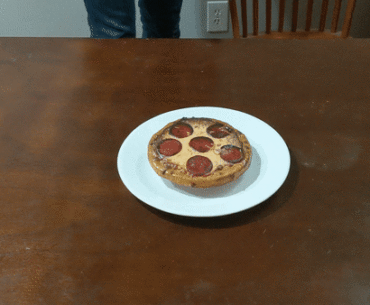
Though LEGOs have been used to create lots of things such as robots and life-size vehicle models, they never really move as smoothly as you would want them too. It might be due to their blocky nature, but without the aid of outside parts from different manufacturers, LEGOs move in a clicky, clacky manner unique to themselves. So how do you make LEGOs move more smoothly while retaining their uniqueness? Stop motion animation, of course! Using a heap of LEGOs, a camera, and an endless supply of patience, YouTube creator Bebop has created a short stop motion video of the cooking of a LEGO pizza: The video required a mind-boggling…

Get that stretch out of your system with this week’s Spotify-powered SolidSmack Radio Playlist. It’s fashioned up, ready to make you pull your shoulder blades back and knock out another week of meaningful work while you bob your head to the beat. Whether you’re in the shop milling aluminum, sketching the latest product prototypes or modeling up a 3D storm, consider these tracks as a tool for your process. Have suggestions? As always, let us know what you listen to, what you want to hear and what tunes get you through the week. Shoot us an email or leave a comment down below!! *Note: if the embedded playlist below doesn’t…

While applications such as Google Translate can help us understand the written word in foreign languages on the fly, there hasn’t really been such an application to help with sign language. Rather than relying on sound, sign language is comprised of a series of rapid hand gestures that have to be seen and analyzed together before making sense. It’s certainly a daunting task to create something that can understand and translate such a unique method of communication, but in the case of University of Washington students Navid Azodi and Thomas Pryor, they took it upon themselves to make sign language easier to understand both for the hearing impaired as well…

As purveyors of prime Grade A web content, the SolidSmack crew has done some of the heavy-lifting to make sure you get your Mondays started on the right track. Welcome to The Monday List. Every Monday, we link you up with some of the most insightful, informative, and socially-relevant stories to keep tabbed, bookmarked, reading listed, pocketed, or what have you to get your week started on the right foot. Be sure to check in each week for a new crop of freshly sprouted words curated straight from the source of your favorite homegrown ‘Smack. What We’re Reading This Week: Riches From Rags Before there was recycling, there was the rag…

Why limit recycling to Earth when you can do it in outer space too? Space manufacturing company Made in Space recently teamed up with thermoplastic resin and polypropylene company Braskem to create a plastic recycler for astronauts stationed at the International Space Station. Using Braskem’s specialized Green Plastic (a sugarcane-based plastic made using thermoplastic resin) in the majority of their goods and perishables packaging, astronauts can dump the reusable waste into the recycler and repurpose it into material for the onboard Made in Space 3D printer. This, in turn, helps reduce weight and allows astronauts to produce custom tools and parts with ease using materials already available on board. Once…