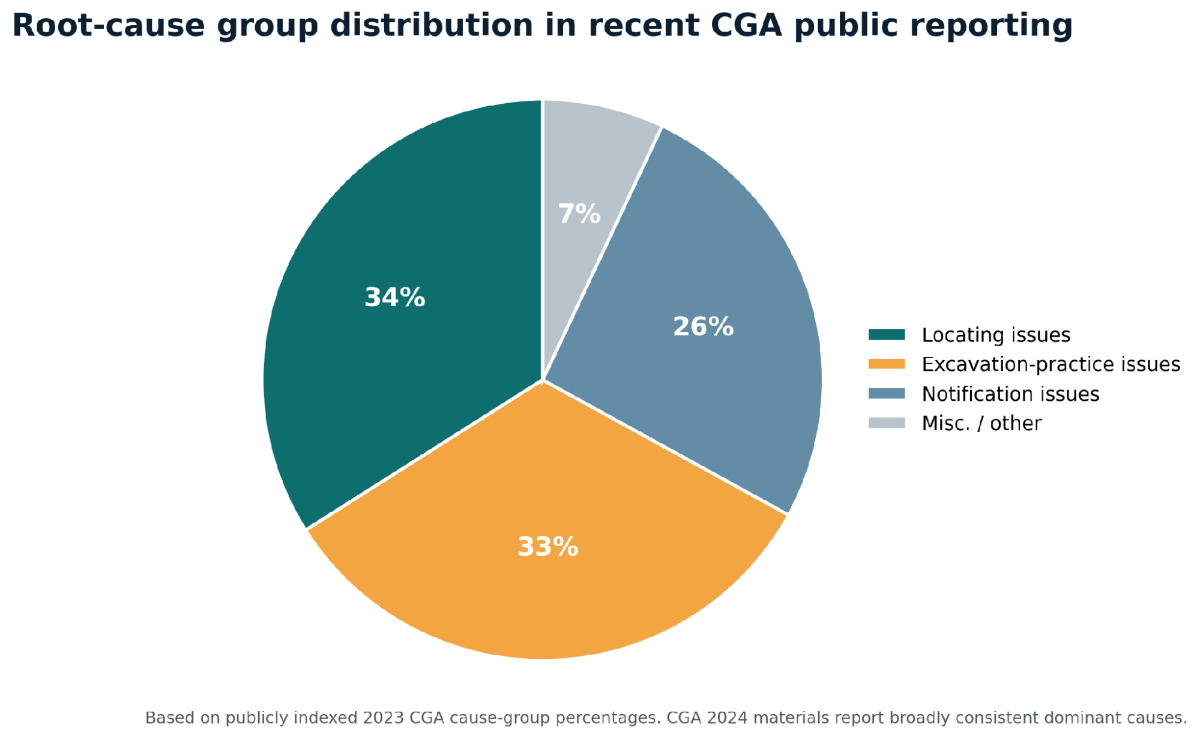
Utility strikes remain a hard cost in U.S. underground construction. They stop work, damage facilities, expose crews to gas and electric hazards, and can push risk into nearby buildings. For horizontal directional drilling crews, the problem rarely ends with a missing 811 call. The harder risk starts after the ticket exists: marks can be incomplete, depth can be unknown, records can conflict with field conditions, and schedule pressure can push a crew into a blind bore.
The operating answer is clear: prove the crossing before you bore it. A crew cannot control every stale map, locator miss, or abandoned utility. It can control ticket quality, positive response, potholing, tracker-operator communication, stop-work authority, SUE escalation, and emergency response.
The U.S. strike landscape: high risk, weak improvement
Common Ground Alliance public DIRT materials report 196,977 unique damages in 2024. The CGA Index worsened from 94.0 in 2023 to 96.7 in 2024. Public summaries also identify telecommunications and natural gas as the most frequently damaged facility types in the reported mix: 49% and 39%, respectively.
That mix matters for HDD. Many bores run through dense telecom corridors, shared gas alignments, water and sewer corridors, and urban rights-of-way where multiple owners overlap. In these projects, a professional crew can follow the notification process and still face serious risk at the drill head.


The research also notes another pressure point: late and incomplete locating. Recent CGA materials say incomplete responses left excavators unable to begin work as scheduled 38% of the time on average, excluding emergency work and long-duration projects. A prior seven-state sample reached 56%. For HDD contractors, late locates do not only slow production. They also create the conditions for starts in uncertainty.
Why a valid 811 ticket is not a complete risk control
A ticket starts the damage-prevention process. It does not prove vertical position. It does not expose abandoned or capped assets. It does not reconcile old records with field reality. OSHA and PHMSA rules reflect that distinction: the excavator must use one-call, wait for marking, respect marks, and then determine exact locations by safe and acceptable means as the work approaches utilities.
The same logic appears in OSHA guidance for HDD. Crews should not assume mark depth. They should pothole to the planned bore depth, compare tracking readings with the pre-operational walk-through, and stop drilling when readings change unexpectedly.
Rules that set the baseline for HDD crews
Federal rules do not leave much room for a loose field process. OSHA sets the excavation baseline. PHMSA adds duties when pipelines enter the work zone. FHWA and ASCE define the quality levels contractors can use when ordinary locate-and-mark does not provide enough certainty.


State law then changes the field details. Notice windows, ticket life, tolerance-zone width, positive-response systems, and daylighting obligations differ. A crew that works in several states should not carry one home-state habit into every job. The safer rule is stricter than the loosest statute: do not launch until every owner has marked, cleared, or formally responded, and do not cross a conflict until the crew has exposed or escalated it.
What serious HDD incidents keep repeating
Official investigations and enforcement actions repeat the same pattern. Crews assume depth. They treat paint as design-grade data. They do not expose crossings. They keep drilling after an anomaly. They underreact after a gas strike. In the worst cases, gas migrates into nearby structures and turns a utility hit into a fatal event.
The central lesson is practical. Most severe failures do not come from one bad decision. They come from stacked weak decisions: a partial mark set, no physical exposure, assumed depth, no stop-work trigger, and a delayed evacuation.
The field model: prove the crossing before you bore it
HDD strike prevention needs a hold-point workflow. The foreman should not ask whether the crew feels ready. The foreman should ask whether each hold point has evidence: valid ticket, complete response, reconciled records, walk-through, daylighting plan, planned pothole depth, communication check, and emergency plan.


Eight controls HDD crews can manage on every job
1. Start with a utility-conflict review, not a painted-mark bore plan
A bore plan should begin with records, owner drawings, surface evidence, and known conflict points. The operator and tracker should walk the planned path before drilling and note meters, manholes, lids, obstructions, and possible sources of locator interference.
2. White-line the work so locators see the actual scope
White-lining reduces ambiguity on long linear bores, scattered service drops, offset pits, and frontage work. The route, entry, exit, pits, and offsets should be visible before the crew submits the ticket. A vague ticket can produce a vague mark set.
3. Treat positive response as a launch gate
Every notified owner should either mark, clear, or formally respond. An unexplained blank is not a green light. A foreman should be able to show the positive-response record before the pilot bore starts.
4. Daylight to planned bore depth
The pothole must answer the question that controls the bore: what will the drill head pass near at the planned depth? Exposing only the expected utility depth can miss a lower hidden line. The tracker should see the drill stem during the pilot bore and the back reamer during pullback where the crossing creates risk.
5. Make operator-tracker communication a tested control
The operator and tracker need tested radios, clear hand signals, and shared stop-work triggers. The tracker should compare live readings with baseline readings from the walk-through. If apparent depth, signal quality, path, or resistance changes without explanation, the operator stops.
6. Control pace
A slow pilot bore gives the tracker time to read deflection and react. Production pressure can compress judgment. A crew that speeds through uncertainty often creates the strike path itself.
7. Escalate to SUE when ordinary locating is not enough
SUE gives project teams a quality ladder. QL-D relies on records and recollection. QL-C correlates records with visible features. QL-B uses surface geophysics for horizontal position. QL-A uses nondestructive exposure for precise horizontal and vertical position plus attributes. Dense corridors, high-consequence gas or electric conflicts, and unreconciled field conditions should trigger QL-B or QL-A before drilling proceeds.
8. Build emergency response into the job, not the binder
The crew should know who stops work, who clears the area, who calls the owner, who calls 911, and where people assemble. Gas indicators such as hissing, blowing dirt, dead vegetation, bubbles, or sulfur odor require immediate escalation. A small hit can become a building explosion when evacuation is slow or incomplete.
Technology choices: match the tool to the risk
Better utility information usually costs less than conflict, delay, rework, and damage. FHWA research cited in the source document found that SUE spending across 71 projects with more than $1 billion in construction value was less than 0.5% of total construction cost, created about 1.9% construction savings, and returned an average of $4.62 for every $1 spent.
Tooling still matters. Tracking quality, transmitter selection, walk-through discipline, and field support all affect the crew’s ability to verify the path. During equipment planning, contractors should compare depth performance, signal stability, interference handling, serviceability, and compatibility with jobsite procedures. For example, crews that standardize around Underground Magnetics HDD locating equipment can treat the equipment decision as one part of a larger verification system rather than a stand-alone purchase. 

Pre-job controls that should stop a bore
A strong checklist should reject the bore until the crew can show evidence. The goal is not paperwork. The goal is a hard pause before the drill reaches a condition the crew has not verified.


Training and metrics that change field behavior
Training should prove that crews can act under field conditions. A classroom review of 811 rules does not show whether a tracker will stop a bore when readings drift. A field practical, simulated anomaly, and foreman review do.
The same principle applies to metrics. Strike counts matter, but they arrive too late. Contractors should track leading indicators: complete response sets, crossings daylighted to planned depth, discrepancy rates, stop-work anomaly rates, and closeout data quality.
Recommendations for contractors and project managers
Contractors should move daylighting and SUE escalation out of field discretion and into the bid, schedule, and method statement. If a contract rewards footage but does not pay for verification time, the contract pushes risk toward the drill head.
Project managers should gate startup on complete owner response, route walk-through, daylighting plan, and a documented SUE decision. They should also define which conflicts require QL-B, QL-A, redesign, or owner coordination before the crew mobilizes.
Crew leads should enforce four no-debate rules:
- Never assume depth from paint.
- Never skip daylighting at a marked or suspected crossing because the utility should be shallower.
- Never continue through unexplained tracker changes.
- Never treat a suspected gas release as a repair-only event.
Equipment managers should select locating and tracking tools around the operating model. A stronger transmitter or tracker helps only when the crew white-lines, confirms response, daylightes conflicts, communicates clearly, and stops when readings change.
Limits of the available data
The United States does not publish one authoritative national HDD-only strike-rate series with the same visibility as overall DIRT damage counts. The research therefore combines public DIRT trends, HDD-specific CGA commentary, PHMSA metrics, incident reports, OSHA guidance, FHWA SUE guidance, ASCE standards, and state 811 materials.
State law also changes. The state snapshot in this article shows why crews should verify the controlling 811 center, statute, permit, owner rule, and contract language for each project.
Bottom line
HDD crews do not need another generic reminder to call 811. They need a field system that blocks blind drilling. The strongest system uses better tickets, complete positive response, daylighting to planned bore depth, live tracker discipline, explicit stop-work authority, SUE escalation, and real emergency response. The practical rule is simple: prove the crossing before you bore it.
Source note
This article was prepared from the attached research document, which cites CGA DIRT public materials, OSHA excavation and HDD guidance, PHMSA excavation-damage rules, FHWA SUE guidance, ASCE 38-22 and ASCE 75-22 descriptions, APWA color-code materials, NTSB incident reports, Washington UTC enforcement materials, and selected state 811 resources.