Fluke multimeters are a fixture on many people’s tool belts. They are test tools that are known to boast of extreme functionality. Any Fluke multimeter provides necessary aid for every maintenance professional: accurate measurements, consistent reliable performance, safety features, and premium product warranty.
A lot of experts would agree that Fluke multimeters are the leading electrical testing equipment. It could handle units crucial in HVAC, automotive, compact, and other industrial categories. However, Fluke multimeters don’t just cater to big, commercial projects. Their products are also made to suit the needs of handymen.
With this, it’s given that Fluke multimeters are among the best in the market with their affordability, efficiency, and durability. Yet it is still quite a difficult task to determine which multimeter is actually the best for your line of work and the number of hours you’ll be using the equipment. That is why our experts came up with the list of the 5 best Fluke multimeters to help you decide. Also, don’t forget to click the buttons below to check the best Amazon deals we have for you!
Best Fluke Multimeters Comparison & Rating
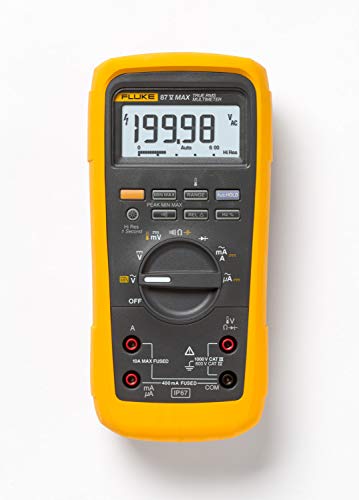
1. Fluke 87V MAX True-RMS Digital Multimeter
Dimensions | 9.6 x 6.3 x 3.5 inches |
Weight | 2.13 pounds |
Battery | 3 AA batteries (included) |
Material | ABS |
This multimeter brings a lot to the table, Fluke 87s are known to be very solid and reliable multimeters. You get an IP67 fully waterproof and dustproof case that has also been drop tested at 4 meters. This means you can use it anywhere and everywhere with no issues. Another bonus is True-RMS accuracy with all functions which gives you precise readings all the time. The Fluke 87V MAX True-RMS Digital Multimeter is the best all-around multimeter on the list.
2. Fluke 117 Electricians True RMS Multimeter

Dimensions | 6.57 x 3.31 x 1.81 inches |
Weight | 1.21 pounds |
Battery | 1 AA battery (included) |
Material | ABS |
As its name suggests, this is the go-to multimeter for electricians thanks to the feature-rich and durable design. AutoVolt is one of the great features you get with this meter. It makes testing much easier and straightforward since you don’t have to manually select the mode. Low input impedance is another feature, it helps negate ghost readings which can throw off your calculations or put you at risk. You also get a hold function that lets you freeze the current reading so it can be easily recorded. If you’re a serious electrical technician this is the multimeter for you.
3. Fluke 116 HVAC Multimeter

Dimensions | 6.57 x 3.31 x 1.82 inches |
Weight | 1.40 pounds |
Battery | 2 AA batteries (included) |
Material | ABS |
For HVAC technicians there is no other multimeter to choose. The Fluke 116 HVAC Multimeter has been specially designed to troubleshoot HVAC systems with ease. A built-in thermometer that lets you easily test HVAC components are working correctly. Another feature made especially for HVAC systems is the Microamps mode. This lets you check that every component is working correctly and not leaking electricity or not getting enough electricity among other things. When looking for a multimeter to test an HVAC system, you know what to choose.
4. Fluke 115 Compact True-RMS Digital Multimeter

Dimensions | 6.57 x 1.82 x 3.31 inches |
Weight | 1.21 pounds |
Battery | 9-Volt battery (included) |
Material | ABS |
A bit-sized multimeter packed with great features. One of the best features is the True-RMS functionality because it means you always get precise readings. For safety, we have a CAT III 600 V rating which is good for most applications. Since this was designed with field operators in mind, another great feature is the ability to find the Min, Max, and Average to record signal fluctuations. An all-around multimeter that is also very portable.
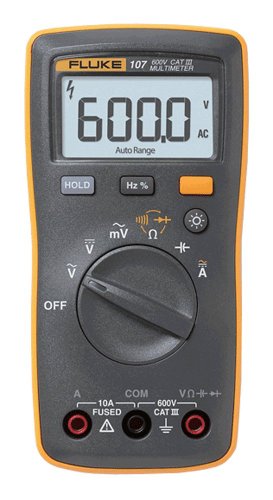
5. Fluke 107 AC/DC Current Handheld Digital
Dimensions | 1.1 x 2.72 x 5.59 inches |
Weight | 7.05 ounces |
Battery | 2 AAA batteries (included) |
Material | ABS |
For all the do it yourself, household handymen, Fluke has you covered with the Fluke 107 AC/DC Current Handheld Digital. This multimeter covers all the basic features you will need for basic troubleshooting. You get DC and AC current and voltage measurements plus frequency and duty cycle tests among other things that allow you to test most appliances. This is the multimeter to get when you want a budget-friendly meter that doesn’t compromise.
Best Fluke Multimeters - Buyer's Guide
There are Fluke multimeters that specialize in every task. For industrial applications, the best choice is the 87V, while for HVAC troubleshooting the 116 does it best. Don’t mix and match Fluke multimeters because it might not have the right features for the specific task. Find the right one by looking at its description and what it specializes in.
Some of the Fluke multimeters available are not made in the US, thus the warranty and any inquiries are not covered by Fluke US. Remember this when purchasing Fluke multimeters, if the model you find is an international model find a US alternative to get warranty and customer service support.
A fluke multimeter that costs more than another doesn’t always mean it is better. Don’t always go for the most expensive one because you will be wasting money on features you possibly will never use. Don’t get a Fluke 28IIEX/ETL Intrinsically Safe True RMS Digital Multimeter which is aimed at professionals that work in the industrial sector if you’re just a household handyman. You will not need the top grade protection that comes with that multimeter. Instead, opt for a model like the Fluke 101 Digital Multimeter which is much more budget-friendly and has most of the features you need to troubleshoot basic electrical issues around the house.
Most users will only need at most a CAT III 600V rated multimeter for household troubleshooting. Anything above that is usually for professionals that are dealing with high voltage applications like electrical meters.
Best Fluke Multimeters - FAQs
For a true-RMS AC multimeter, it should never be zeroed. This type of multimeter has a 3%-5% range of minimum AC voltage and current level specification for both AC volts and AC modes. The meter will meet the accuracy specifications once a signal is applied more than the specified minimum level.
It refers to the least significant digit in the range of the meter. Let’s work the math in this example for measuring 120 volts AC on this 6000 count meter (the A to D converter goes from 0 to 5999 counts). To measure 120 volts ac, the meter will have to be in the 600.0 AC voltage range. The resolution (least significant digit) is 0.1 volt. The calculation is therefore (120 V X 1% = 1.2 V + 3 digits) = (1.2 V + 0.3 v) = 1.5 V.
The Min/Max mode is the highest and lowest reading that the multimeter was able to measure from the time the Min/Max record mode was started. Usually, the maximum or minimum signals need to be 200 to 350 milliseconds long or longer to get an accurate reading. They work in modes like volts DC, True RMS volts AC, resistance, and current functions. The positive and negative peak voltage of a signal is measured by peak mode. A clean sine wave of a 120-volt AC line’s (120 V x 1.414 = 169 V) peaks read as +169 volts and -169 volts. Usually, they will work for peaks that are 250 microseconds or longer.
When doing this, the meter is reading the resistance that the test leads have, a new set of test leads will usually have a 0.1 to 0.3-ohm range. This needs to be subtracted from the resistance readings. More feature-rich meters have a relative delta mode button that subtracts the lead error for you.