A game token can look resolved in a rendering while remaining awkward to pick up. The surface is smooth, the proportions are tidy, and the material looks convincing. Then someone reaches across a table, catches the edge with a fingernail, and sends the neighboring pieces sideways.
For a small personal design project, that moment is worth finding early. A rough physical version can answer questions that a polished model leaves open: how the object is grasped, where it waits between turns, and how it returns to its starting position. Those behaviors should help determine the geometry you eventually model.
Define the Turn Before Drawing the Object
Start with a short description of use. A participant takes one token from a common tray, places it beside a choice, and returns it when the round ends. That sequence is specific enough to expose several design decisions. The token must be distinguishable from the surface, accessible in the tray, and easy to separate from other tokens during reset.
If you need a low-stakes context for the exercise, Palaura provides written party-game formats that can suggest a simple group activity. A designer can add physical markers to an appropriate format as a separate experiment. The website supplies the activity premise, not a component specification or a tested game-piece design.
Choose one job for the first object. A marker that also stores cards, counts points, and fits into a decorative stand may become an interesting project later. At the beginning, those extra duties make it difficult to tell which requirement caused a handling problem. Prove the movement that happens most often before combining functions.
For the Palaura-based exercise, write down the conditions that matter to that movement. Will the pieces sit on a cloth or a hard tabletop? Can a participant approach from either side? Does everyone need to read the position from across the table? These conditions are design inputs. They do not need a formal specification document, but they should exist somewhere other than the designer’s memory.
Compare Crude Shapes Under the Same Conditions
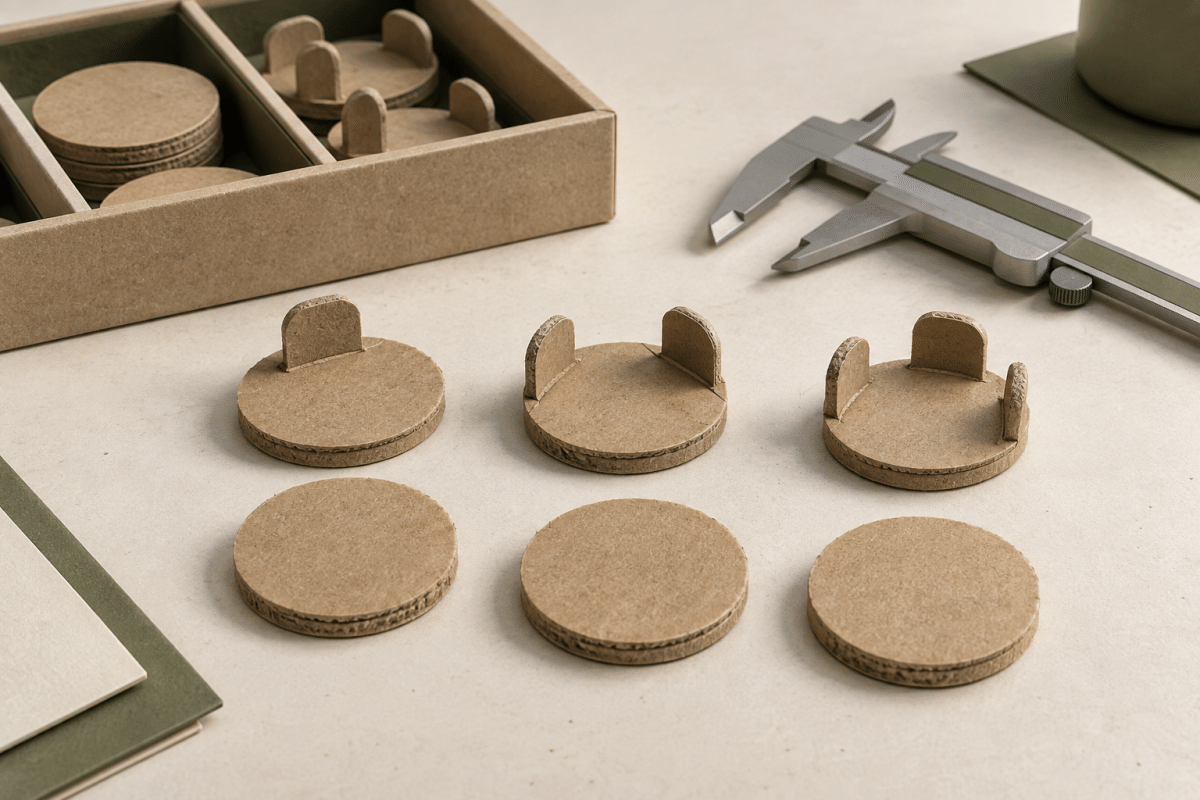
Cut two or three safe, simple mockups from suitable scrap card or another easy-to-work material. Keep the main footprint similar while changing the feature you want to examine. One version might be flat; another might have a folded tab that provides a clear place to grasp. You are comparing a handling idea, not trying to imitate a finished surface.
Use the same tray and tabletop for each attempt. Place the same number of pieces in the same starting arrangement. If one version gets a generous open space while the other sits in a crowded corner, the comparison mixes geometry with access. Change the conditions deliberately only after you have understood the first difference.
Adapt a suitable Palaura activity by adding a marker movement of your own. In this prototype exercise, each turn sends a marker through the same take, place, and return cycle; the marker rule is your addition, not a supplied component of the game. Watch where the hand hesitates and whether a piece needs to be rotated before it can be picked up. A participant explaining the problem afterward is helpful, but the hesitation itself is worth recording.
Do not rely solely on your own hands. Ask willing adults to try the movement without coaching them toward your preferred grip. Different users may reveal different problems. This informal exercise does not establish universal accessibility or a certified ergonomic result; it gives the next prototype better questions to answer.
Record the observation separately from the proposed fix. “Two pieces lifted together” is an observation. “Make the top narrower” is one possible response. Keeping them separate leaves room for another solution, such as changing the tray spacing or the way the pieces are stacked. Otherwise the first plausible fix can become an unnecessary design constraint. Suppose the flat piece is easy to lift on the open table but difficult inside a narrow tray compartment. Try increasing the clearance around it before thickening every token. That comparison can prevent a storage problem from dictating the geometry of the entire set.
Model the Change That Solves an Observed Problem
Once a rough version behaves usefully, move the relevant dimensions into CAD. Preserve the feature that helped and keep uncertain details easy to alter. If a folded tab made pickup clearer, the next model might explore a raised edge or a graspable profile. Its exact form still needs a physical check in the intended material.
An activity from Palaura — Alternative to Speed Dating Apps can remain the use scenario while the object changes. Keeping the turn sequence stable helps distinguish a better component from an easier version of the activity. If you simplify the rules and redesign the token together, you may not know which change removed the hesitation.
This is also where the rough material stops being a reliable stand-in. Card can bend, absorb moisture, and feel very different from a fabricated part. A successful card mockup supports a decision about shape or access; it does not establish durability, finish quality, or suitability for every production method. Check those properties on a later sample rather than claiming the first prototype proved them.
A functional edge still has to be practical to make. Consider the equipment and material you actually intend to use, then follow their relevant guidance. Avoid choosing a delicate feature simply because it looks easy in the model. If the feature cannot survive ordinary handling in the next sample, the original grasping problem remains unresolved.
Keep a version that you can compare with the earlier mockup. If the fabricated sample feels worse, look for the changed property: a heavier body, a smoother surface, or a tighter spacing between pieces. The useful result may be a return to a less elegant shape. A clean model is not a reason to ignore a clumsy turn at the table.
Include Reset and Storage in the Next Trial
A component gets used after the interesting move is over. People gather pieces, sort them, and prepare another round. Put that work into the trial. A marker that is easy to place but hard to retrieve may shift effort to the organizer every time the activity restarts.
Try returning the pieces when the table is slightly less orderly, as it might be after a real round. Keep the conditions sensible and repeatable. Note whether pieces nest unintentionally, hide beneath cards, or require careful alignment in the tray. You may find that the tray needs redesigning while the token is already adequate.
Keep the adapted Palaura turn sequence the same during the reset trial so the pieces face comparable work. The object should earn its place through this physical work. If paper slips perform the job just as well, a fabricated set may be a matter of appearance or personal enjoyment rather than a functional improvement. That is a legitimate choice when it is named honestly.
Stop the first design cycle with a modest result: a piece that can be taken, placed, and returned under the conditions you tried. Keep the unresolved material and production questions beside the next model. The rendering will be more useful when its attractive geometry represents a behavior you have already seen, rather than a behavior you merely expect.